


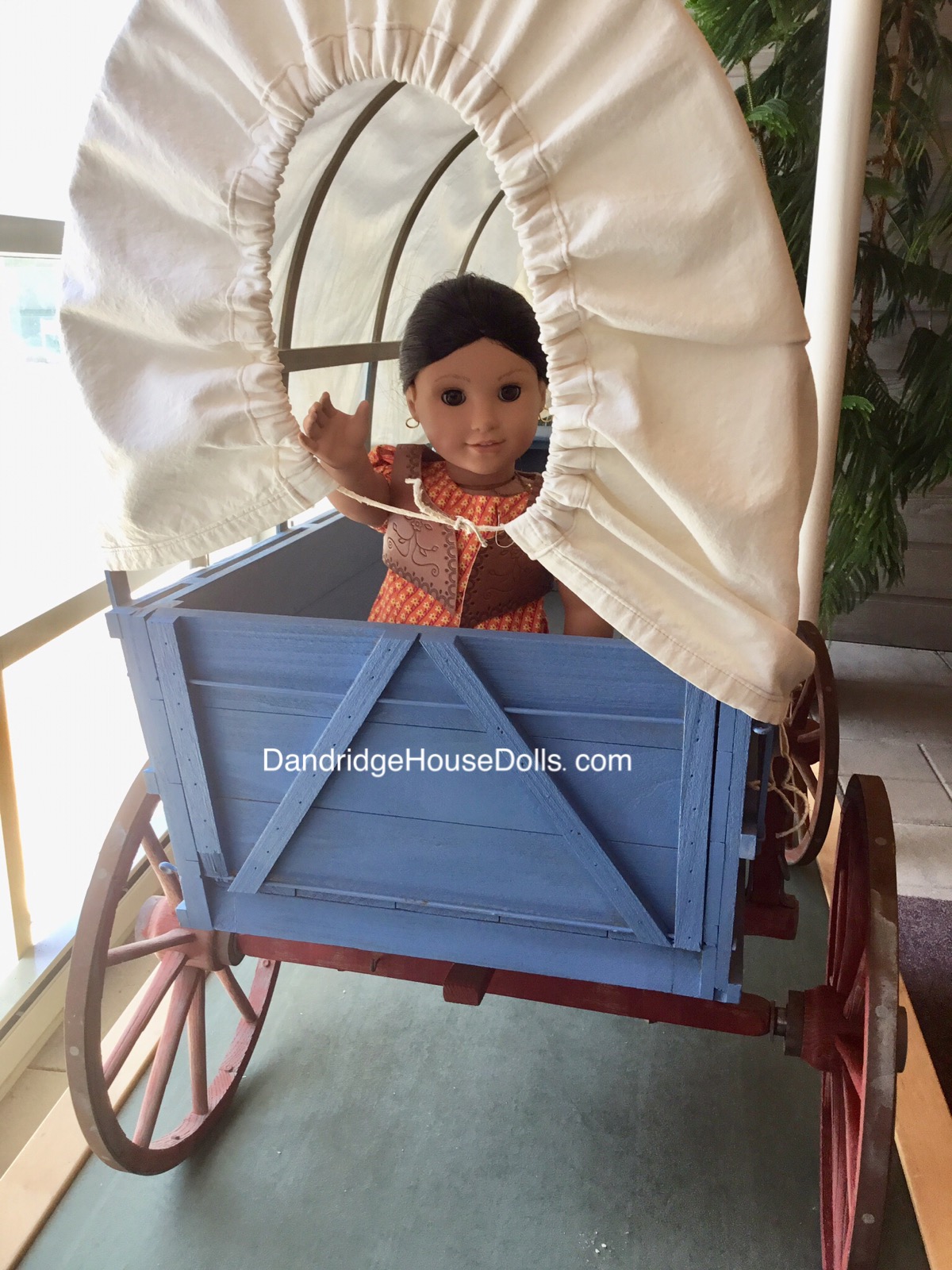
Josefina Montoya is a wonderful addition to the American Girl collection. Her book series is set in 1824 New Mexico. In the stories, Josefina lives on a rancho 15 miles from Santa Fe. I live in the middle of the country so I don’t get to visit very many early Spanish-American historic sites. When I discovered the National Frontier Trails Museum in Independence, Missouri I thought Josefina would be the perfect doll to go with me.

 So what was western life like in Josefina’s day? Prior to 1821, Spain protected the borders of its colony New Mexico and wouldn’t allow them to participate in international trade. Americans that visited Santa Fe came back with stories telling how the New Mexican people were starved of manufactured supplies. The Mexican people revolted against the Spanish rule in 1821 and opened trade to the United States. Immediately the Santa Fe Trail was blazed from Missouri to New Mexico.

A journey on the Santa Fe Trail would have taken 8 weeks to travel the dusty 900 mile trek. It started in Independence, Missouri and there you would need to stock your wagon with supplies for the hard journey ahead. Business boomed in Independence because it was the last town on the edge of the Wild West. Multiple trails started in Independence and families purchased supplies to head west on the California and Oregon Trails. These trails were traveled by settlers wanting a new life for their families. The Santa Fe Trail was mainly traveled by merchants seeking to make a business for themselves. The traders would need to stock up in Independence before heading to Santa Fe. As the traders returned from New Mexico they brought beautiful goods into Independence.


On the Santa Fe Trail, travelers would have to endure long stretches of boredom, mosquitoes and heat that would be interrupted by scary hailstorms, wildfires and swollen streams. Buffalo herds roamed the land by the thousands. Traders reported that the plains would look black as far as the eye could see from all the bison. The trail hands would start their day at dawn and get their large Conestoga wagons moving with loud hollers and whoops. A Conestoga wagon was a freight wagon that could haul 3,000 pounds. It had a curved bottom floor that was designed to keep the cargo from shifting. The sides had chain to tighten to keep the wagon’s sides secure if the load was large. It had a built-in tool box and feed box on the sides or underneath. In 1824, Conestoga wagons would be like our modern-day eighteen-wheeled transport trucks. The Conestoga wagon pictured is dated 1827.

Mid-morning the trail hands would stop to let the oxen teams graze and they would cook their largest meal of the day. Each trail hand had a daily ration of one pound of flour, one pound of bacon, one ounce of coffee, two ounces of sugar and a pinch of salt. Occasionally, they would get a treat of dried apples or beans. The food would be cooked on gathered wood and fueled by buffalo chips. The caravan would start moving again around noon and keep pace until evening. At the day’s end the crew would take care of the animals and repair any wagons that needed attention. Finally they could get some much deserved rest.


When American traders finally arrived in Santa Fe’s dusty marketplace, they found it bustling with an amazing mixture of people and cultures. Santa Fe had New Mexicans, Spanish settlers, French fur trappers and Pueblo Indians. Girls like Josefina would have found the arrival of the wagon train a thrilling event. The traders would rent small store fronts or set up wooden stalls for people to shop and trade. Josefina would have been mesmerized by the wares she saw like mirrors, tools, cotton fabric, toys, hats, boots, combs, silk, books and so much more.


In Josefina’s books, a flash flood destroys a large part of her family’s herd of sheep. To try to rebuild their herd, the whole family pitches in to weave as many blankets with the stored wool as possible to earn money so they can buy new sheep. When the wagon train comes into Santa Fe, Josefina’s father allows each of his daughters to have one of the blankets to trade for any item they want for themselves. Josefina fell in love with a little toy farm. Her new friend, the American trader Patrick O’Toole tells Josefina how much the toy looks like his home in Missouri. Even though she wants the toy badly, she trades her blanket for a violin to give her papa. Patrick surprises Josefina by giving her both the violin and the toy farm!

New Mexico became an American territory in 1850 and finally a state in 1912. In the late 1800s the Santa Fe Trail was replaced by the railroad and more Americans moved into the area. In Josefina’s lifetime she would have lived under three separate ruling governments; Spain, Mexico and lastly the United States. The Santa Fe Trail blazed the way to bringing New Mexico into the Union. Our county has been enriched by what Hispanic culture has brought us. I’m so glad that Josefina became an American Girl!


Leave a Reply